A step-by-step, positive reinforcement potty-training plan with a strict daily schedule, crate training basics, and troubleshooting for common setbacks.
I grew up in a house where there was almost always a foster dog decompressing in someone’s spare bedroom, and later, as a vet tech, I saw the same pattern again and again: good dogs labeled “bad” simply because their people did not have a plan. Crate training is one of those plans that can change everything, not by forcing a puppy to “deal with it,” but by teaching them that the crate is a safe, predictable place where good things happen.
This guide stays in its lane: we are teaching the crate itself. Not house-training from scratch and not a full separation anxiety protocol. Think of it as the step-by-step blueprint that makes both of those other goals easier later.
What crate training is (and is not)
Crate training is teaching your puppy to choose calm in a small, cozy space for short periods, then gradually longer ones. A well-crate-trained puppy can:
- Walk into the crate willingly
- Relax with the door open and closed
- Settle for naps
- Wait quietly to be let out
Crate training is not “let them cry it out for hours,” and it is not a substitute for exercise, enrichment, or human interaction. The crate is a tool, not a lifestyle.
Step 1: Choose the right crate size
Right-sizing matters because it keeps the crate comfortable and reduces accidents. Your puppy should be able to:
- Stand up without their ears touching the top
- Turn around easily
- Lie down fully stretched out
If the crate is too big, some puppies will potty in one corner and sleep in another. If it is too small, they cannot settle and may develop negative feelings about confinement.
Wire, plastic, soft-sided: what to pick
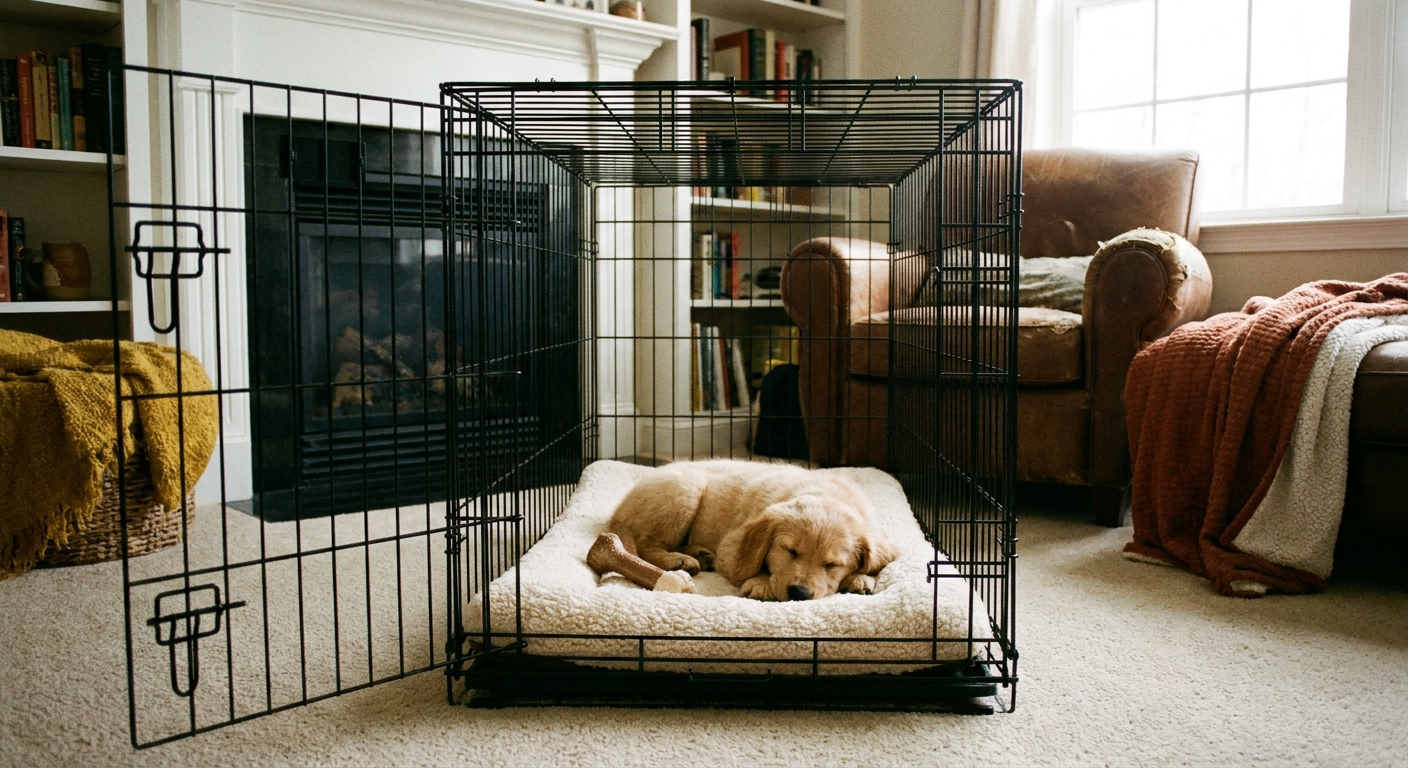
- Wire crates are popular for home use because they are airy, easy to clean, and often come with a divider panel so the crate can “grow” with your puppy.
- Plastic airline-style crates feel den-like and can be great for pups who settle better with more privacy. They also travel well.
- Soft-sided crates are best saved for puppies who already have great crate manners. Many young pups chew or scratch through them.
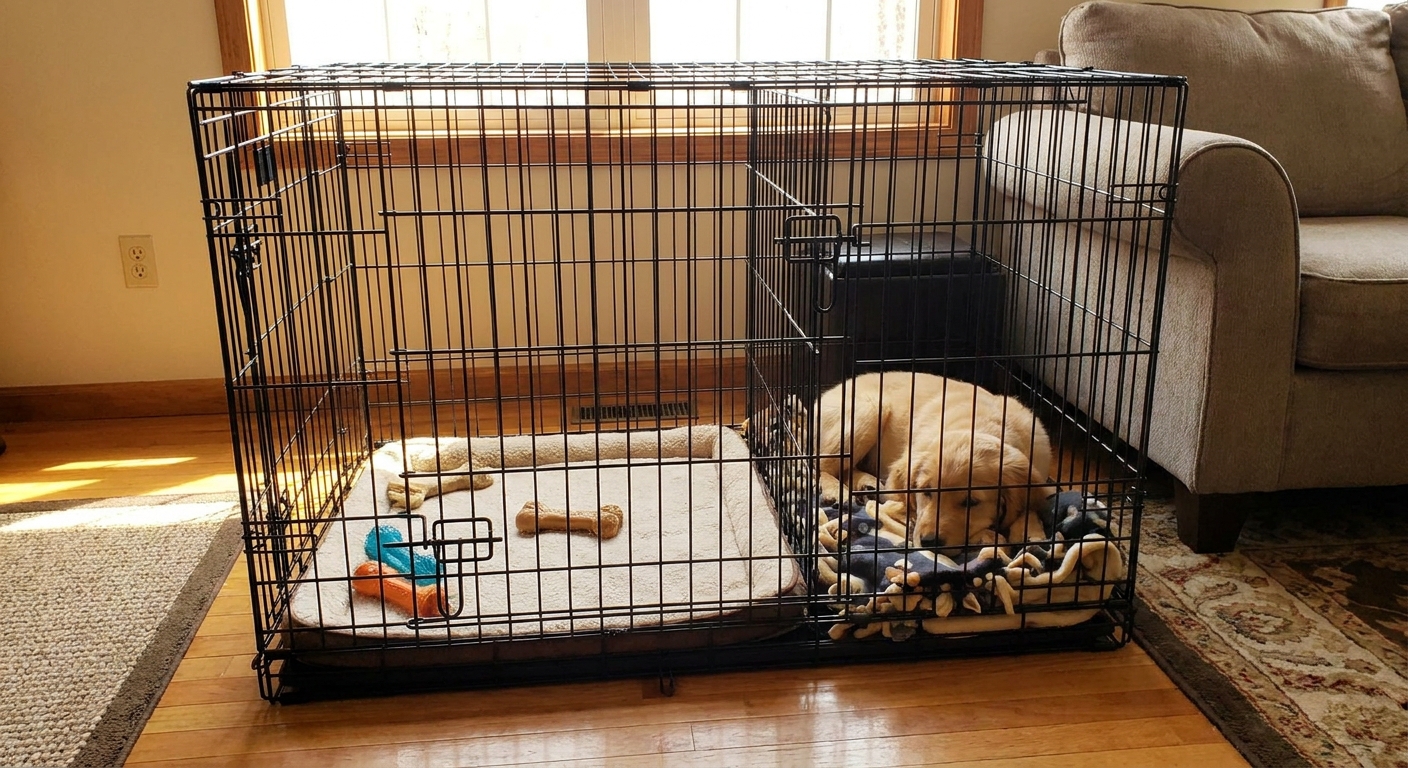
Divider panels: the secret weapon for growing puppies
If you have a large-breed puppy, buy the adult size and use a divider to block off extra space. As your puppy grows, you can expand the usable area without buying a new crate.
Step 2: Set up the crate like a puppy bedroom
The goal is “cozy and safe,” not “fancy.” Start simple so you can adjust to your puppy’s habits.
Where the crate should go
- Daytime: Put the crate where your puppy can see and hear normal household life, like the living room or kitchen area.
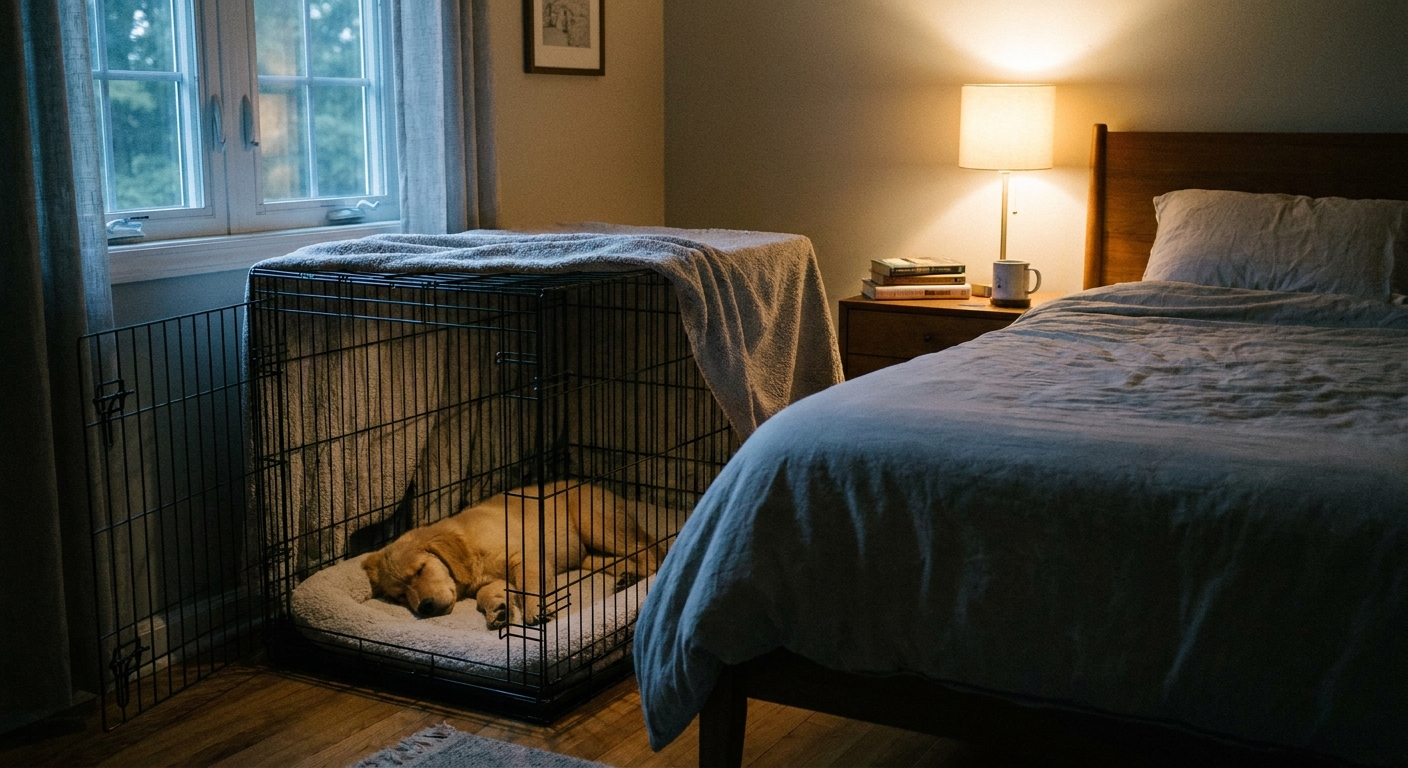
- Nighttime: Many puppies do best when the crate is in your bedroom or right outside it at first. That proximity helps them settle and helps you hear if they need a potty break.
What to put inside
- Safe bedding: A thin mat or towel is a fine start. If your puppy shreds fabric, go bedding-light until chewing improves.
- Water: For short crate sessions, many puppies do not need water inside. For longer daytime crating, talk with your vet about what is appropriate for your puppy’s age and schedule.
- One long-lasting, puppy-safe chew (optional): This can help some pups settle, but remove anything your puppy tries to destroy and swallow.
Collars and tags: a quick safety note
For unsupervised crating, I prefer puppies to be “naked” or in a well-fitted breakaway option. Collars and dangling tags can snag on crate wires in a worst-case scenario. If you are unsure what is safest for your setup, ask your vet or trainer.
Cover or no cover?
Some puppies settle better with a light cover over part of the crate to reduce visual stimulation. Others get hot or anxious. If you cover, keep airflow strong and make sure your puppy cannot pull the fabric inside.
Step 3: Teach the crate with tiny wins
This is the part many people skip, and it is the part that prevents the classic first-week meltdown.
Day 1: Open door, treats rain from the sky
Leave the crate door open.
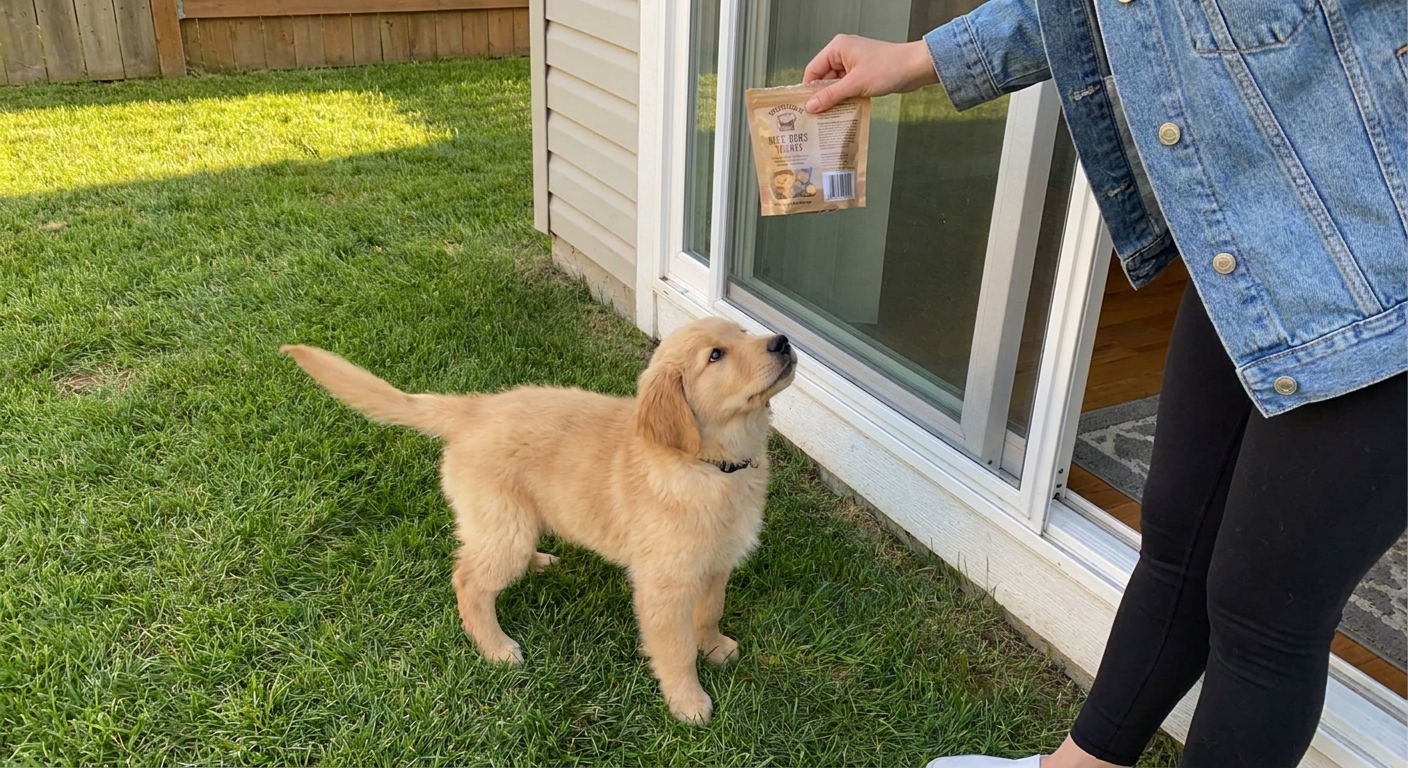
Toss a treat just inside the doorway. Let your puppy choose to step in and get it. Do not push, shove, or close the door.
Repeat for 1 to 2 minutes, then take a break.
Add a cue (optional)
Once your puppy is happily walking in, you can add a cue like “kennel” or “crate.” Say the cue once, then toss the treat in. The cue predicts the fun thing.
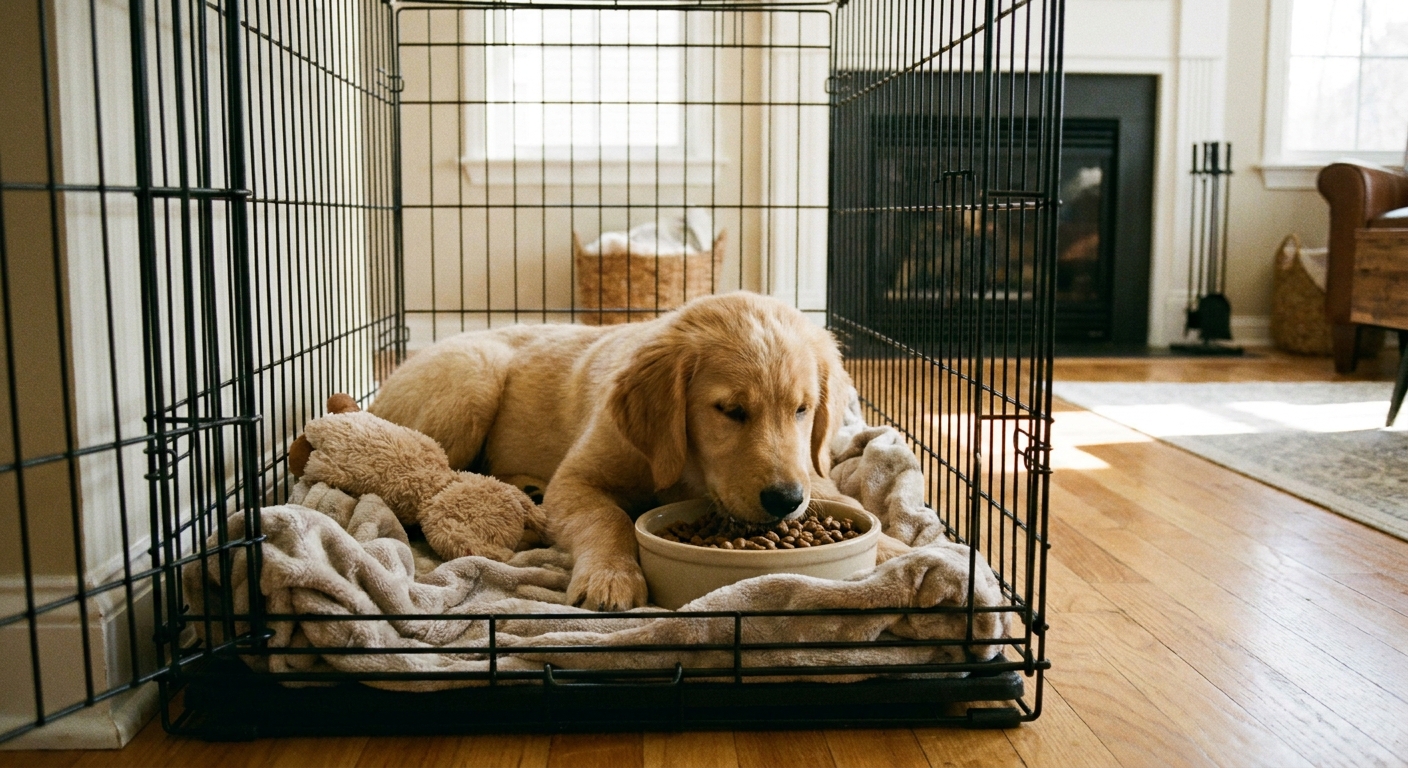
Feed meals in the crate
One of my favorite low-effort hacks: put the food bowl in the crate with the door open for a couple of meals. When that is easy, close the door while they eat, then open it before they finish if you want to keep things extra smooth at first.
Step 4: Close the door for seconds
Closing the door is a separate skill. Teach it gradually, like you would teach “sit” or “down.”
A simple progression
- Step A: Puppy walks in, you quietly close the door, then immediately open it again. Treat.
- Step B: Close door for 5 seconds. Treat through the bars. Open the door while your puppy is quiet.
- Step C: Close door for 15 seconds, then 30, then 60.
Do several short sessions a day rather than one long one. You are building comfort, not endurance.
What success looks like
Success is your puppy staying soft in their body, able to take treats, and choosing to lie down. If your puppy ramps up, you moved too fast. Shorten the time and make it easy again.
Step 5: First-night setup
The first night is where good intentions go to die. So let’s make it boring in the best way.
Do this on night one
- Put the crate near you, ideally within arm’s reach of your bed at first.
- Potty right before bed, then straight into the crate.
- Keep it dark and quiet like bedtime, not playtime.
- Use a consistent phrase like “bedtime” and a small treat for going in.
Should you put your hand near the crate?
For some puppies, yes. If your puppy settles when you rest your fingers near the crate or talk softly, that is a totally reasonable bridge for night one and night two. The goal is to fade that help over time as your puppy learns the routine.
Night whining: potty or protest?
Many puppies, especially under about 12 weeks, will need at least one nighttime potty break. If you hear whining, pause and listen. If it sounds urgent or it has been a while since the last potty trip, take them out calmly. If you suspect it is “I’m awake and I miss you,” wait for a brief quiet moment, then reassure softly without turning it into a big event. Either way, keep nights boring: leash on, quick potty, calm praise, straight back to the crate. No games, no wandering the house.
How long can a puppy be crated?
These numbers are not goals. They are rough upper limits many puppies can tolerate during the day when they have pottied, their needs are met, and they are set up to nap. Size, health, prior conditioning, and whether the puppy actually falls asleep matter a lot.
| Puppy age | Often-tolerated max crate time (daytime) | What to plan for |
|---|---|---|
| 8 to 10 weeks | 30 to 60 minutes | Frequent potty breaks and naps |
| 10 to 12 weeks | 1 to 2 hours | Short crate sessions after play, training, potty |
| 3 to 4 months | 2 to 3 hours | Longer nap blocks, still needs midday breaks |
| 4 to 6 months | 3 to 4 hours | Most pups can handle a solid nap cycle |
| 6+ months | 4 hours (often), up to 5 for some | Build gradually, prioritize exercise and enrichment |
As a general welfare rule, try not to make long crate stretches your puppy’s everyday normal, especially in the early months. Even adult dogs do best with regular breaks, movement, and time with their people.
For overnight, many puppies can sleep longer than they can comfortably hold it during the day, especially once they settle into a routine. Your puppy’s vet can help you set expectations based on size and health.
Important: If your puppy is crated longer than they can handle, you will see more crying, more accidents, and more frustration. That is not stubbornness. That is an unmet need.
A simple daytime rhythm
Puppies are tiny toddlers with sharp teeth. They need a predictable loop: potty, play, eat, potty, nap. A crate makes the nap part possible.
A realistic sample schedule
- Wake: Potty break
- 10 to 20 minutes: Play and a little training
- Meal: Ideally in the crate
- Potty break: Right after eating
- Crate nap: 45 to 90 minutes for young puppies, longer as they age
- Repeat throughout the day
If your puppy acts wild and bitey, they are often overtired. A planned crate nap prevents that spiraling “zoomies then biting then chaos” cycle that makes people think their puppy is aggressive when they are just exhausted.
What to do about crying
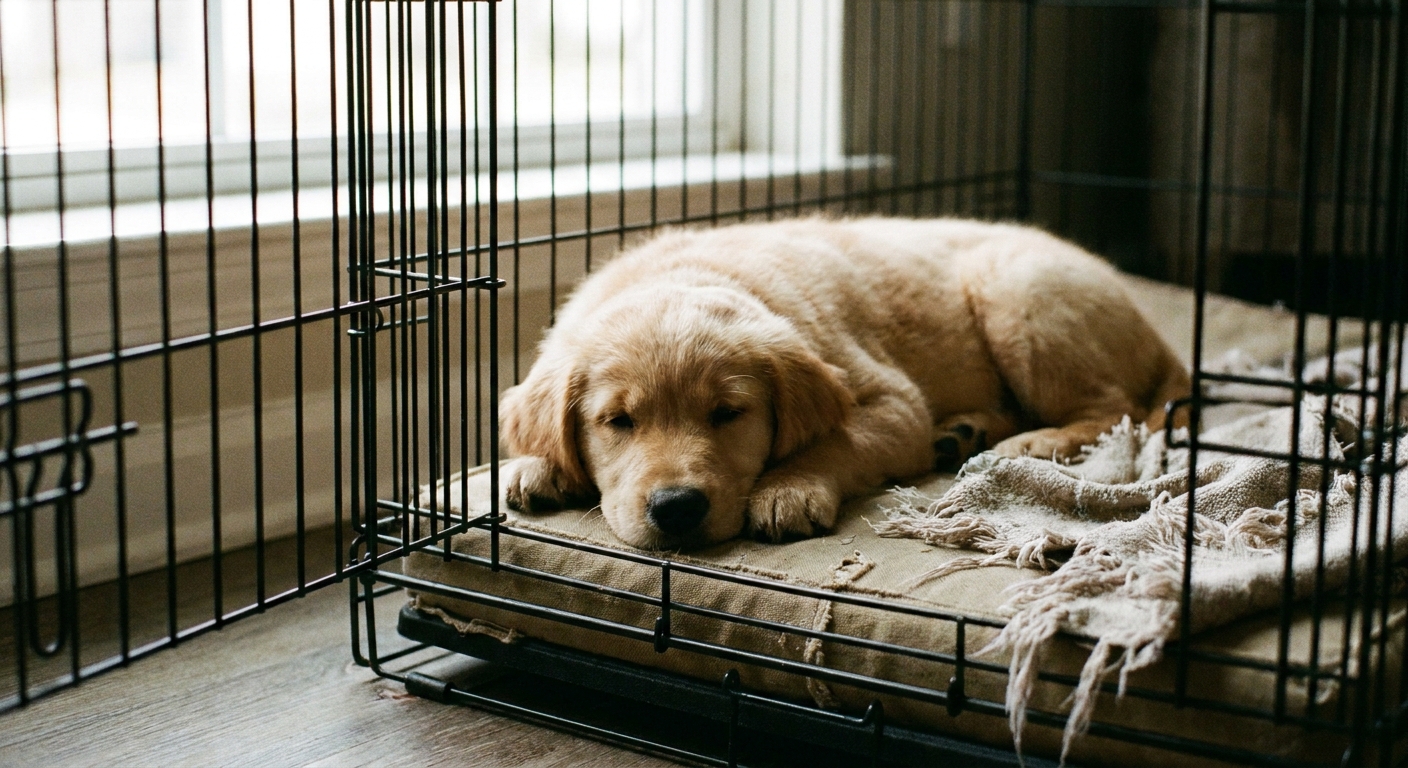
Some complaining is normal. You are teaching a new life skill. The goal is to respond in a way that builds calm, not a habit of “noise opens doors.”
Before you worry about behavior, check needs
If your puppy is crying hard, ask:
- Do they need a potty break?
- Are they too hot or too cold?
- Are they hungry or thirsty?
- Did they have enough physical play and mental enrichment?
The quiet moment rule
If you are confident your puppy’s needs are met, wait for a tiny pause in the noise. That pause might be half a second at first.
- When the barking or whining stops briefly, calmly say a soft marker like “good.”
- Then open the door or offer a treat through the bars.
The timing matters. If your puppy is barking to be released and the door opens during barking, the barking can get reinforced. Opening the door during a quiet moment helps your puppy learn that quiet works.
If the crying escalates, make the next repetition easier
Common fixes that do not involve “letting it ride”:
- Shorten the session. Practice 10 to 30 seconds of calm instead of 10 minutes.
- Increase distance gradually. Sit nearby, then stand, then take one step away, then two.
- Add a calm activity. Offer a safe chew if your puppy settles by chewing.
- Adjust the environment. Move the crate closer, reduce visual stimulation, add white noise if household sounds trigger barking.
When crying is not normal
If your puppy is drooling heavily, panicking, biting the crate bars, or injuring themselves trying to escape, that is beyond typical crate complaints. Do not crate-train through panic. Pause the plan and contact a qualified positive reinforcement trainer or your vet. Intense distress needs a different approach.
Chews in the crate
Chews and food puzzles can be incredibly helpful, but they are not automatically safe for every puppy.
- Match the chew to the chewer. Power chewers and “gulpers” need extra caution.
- Monitor new chews first. If your puppy is trying to break off big chunks, pause and choose a safer option.
- When in doubt, ask your vet. Choking and obstruction risks are real, and the “best” chew depends on your puppy’s age and habits.
Mistakes that make the crate feel like punishment
I have seen so many puppies learn to hate the crate for reasons that are completely fixable. Here are the big ones.
- Only using the crate when you are annoyed. If “go to your crate” only happens after chaos, the crate becomes a social exile. Make sure your puppy goes in when things are calm and happy too.
- Moving too fast. If your puppy can do 30 seconds quietly, do not jump to 30 minutes next.
- Letting kids bang on the crate. The crate must be a no-bother zone. Teach children that the crate is the puppy’s bedroom.
- Using the crate instead of teaching downtime. Puppies still need help learning to settle outside the crate too. Use playpens, leashes, and calm enrichment to spread the skill around.
- Opening the door during demand barking. If barking is being used to ask for release and it works, it tends to grow.
- Crating a puppy who is not tired. A puppy with a full tank will protest. Pair crate time with naps.
Troubleshooting
My puppy will not go into the crate
- Use higher-value treats and toss them just inside the entrance, then gradually deeper.
- Feed meals near the crate, then at the doorway, then inside.
- Check the setup. Some puppies dislike slippery plastic trays. Add a grippy mat.
My puppy settles, then barks when I walk away
- Practice “micro departures.” Step away and step back before barking starts.
- Return while your puppy is quiet, even if the quiet is brief.
- Build duration only after your puppy can handle distance.
My puppy has accidents in the crate
- Recheck crate size. Too much extra space makes accidents more likely.
- Increase potty break frequency and keep a predictable nap rhythm.
- Clean with an enzymatic cleaner so odors do not linger.
- Call your vet if accidents seem sudden, frequent, or paired with diarrhea or vomiting.
My puppy chews bedding or the crate tray
- Remove fluffy bedding temporarily and use a simple towel or crate mat that is hard to shred.
- Offer appropriate chews outside the crate and supervise chew time so you learn what is safe for your puppy.
- Make sure your puppy is getting enough enrichment during awake time.
Crate training checklist
- Size it right: stand, turn, stretch
- Set it up: cozy, safe, in a social area by day
- Safety check: avoid snag risks from collars and dangling tags
- Teach “crate = treats” with the door open first
- Feed meals in the crate to build a positive association
- Close the door gradually in seconds, not minutes
- First night: crate near you, boring potty breaks
- Daytime rhythm: potty, play, eat, potty, nap
- Crying plan: meet needs first, then reward quiet moments
If you stick to these steps, many puppies start to treat their crate like a familiar bedroom within a couple of weeks. Not perfect, but noticeably better. And that is the real win: a home where everyone can rest and your puppy has a safe spot to land.
FAQ
Should I put toys in the crate?
One safe, durable chew can help some puppies settle. Avoid stuffing the crate with multiple toys that could be shredded and swallowed. If your puppy tends to destroy toys, keep the crate simple and offer chews during supervised time instead.
Should the crate door be open during the day?
Yes, when you are home and it is safe to do so. An open-door crate becomes a hangout spot, which strengthens the positive association. You can still do short door-closed practice sessions as part of training.
Is it okay if my puppy whines a little?
A little whining while they learn is common. Focus on preventing long, frantic crying by going at your puppy’s pace, meeting needs first, and rewarding quiet moments.
When can my puppy sleep outside the crate?
That depends on your goals and your puppy’s habits. Many families keep using the crate at night until chewing is reliable, nighttime potty needs are mature, and the puppy can settle safely. There is no prize for ditching the crate early.